
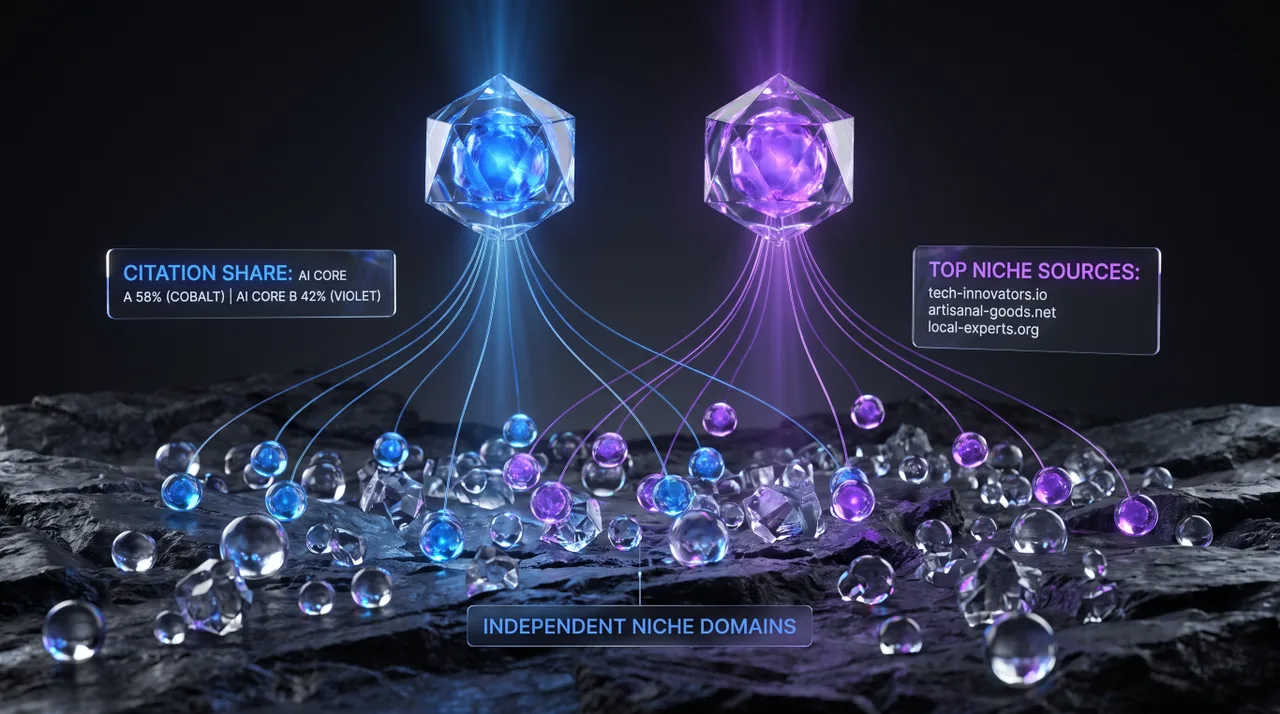
For most niche queries, Gemini cites small brands more often because it grounds answers in Google's full search index, where topical relevance can beat raw authority. ChatGPT leans on training data and a leaner browsing index, so it favors well-known brands unless yours has strong, consistent mentions elsewhere on the web.
When someone asks an AI assistant for a recommendation, the brands it names — and the sources it links — increasingly shape who gets discovered. For small businesses, that raises a sharp question: do Gemini citations favor lesser-known sites more than ChatGPT, or is it the other way around? The answer matters, because a single cited link in an AI answer can send you qualified traffic you never paid for.
This post compares how Google's Gemini and OpenAI's ChatGPT handle citations toward small, lower-authority brands, why their behavior differs, and what you can do about it.
Why citations matter for small brands
Traditional search gave every result a visible slot. AI answers compress ten blue links into a paragraph, and only a handful of sources get named or linked. If you're a small brand up against established players, being one of those cited sources is the difference between existing and being invisible in an AI-mediated search.
Citations do three things for a small business:
- Referral traffic — users click through to cited sources, especially when they want to verify a claim or buy.
- Credibility by association — appearing alongside bigger names signals legitimacy.
- Compounding visibility — once an engine learns to trust your domain, it tends to cite you again.
The catch is that each engine decides who to cite using different plumbing, and that directly affects small brand AI visibility.
How Gemini and ChatGPT source their answers
To understand citation behavior, you have to understand where each model pulls from.
Gemini leans on Google Search
Gemini is tightly integrated with Google's live search index. When it answers a question that needs fresh or factual information, it runs search queries behind the scenes and grounds its response in the results. So Gemini citations largely mirror what ranks in Google — including the long tail of smaller sites that earn organic positions for specific queries.
The practical upside: if your small brand ranks on page one of Google for a niche query, you have a genuine shot at being grounded and cited by Gemini.
ChatGPT blends training data with web browsing
ChatGPT answers come from two places. Its base model draws on training data, where popularity and link density heavily favor large, well-established brands. When browsing is active (via its built-in search), ChatGPT retrieves live results — increasingly powered by its own index and partner sources — and cites them inline.
The result is a split personality. Without browsing, ChatGPT citations skew heavily toward household names. With browsing, it surfaces more variety, but its retrieval set is narrower and more curated than Google's full index.
Which one actually cites small brands more?
After repeated testing across niche commercial and informational queries, a clear pattern shows up.
| Factor | Gemini | ChatGPT |
|---|---|---|
| Primary source | Live Google Search index | Training data + browsing index |
| Long-tail small-site coverage | Broad | Moderate |
| Tendency toward big brands | Lower on niche queries | Higher, especially without browsing |
| Citation link visibility | Usually inline + source panel | Inline when browsing |
| Best path to get cited | Rank in Google | Earn mentions across trusted sites |
For most niche queries, Gemini cites small brands more often. Because it grounds answers in the full Google index, a well-optimized page targeting a specific question can get pulled in even if the domain has modest authority. Gemini citations reward topical relevance at the query level.
ChatGPT is more conservative. Its default instinct is to name the brands it "knows" from training — which almost always means larger, older, more-linked companies. When browsing kicks in, smaller sites get a fairer shot, but you're competing in a smaller retrieval pool.
That said, ChatGPT citations have one advantage for small brands: consistency. Once your brand is well represented across the web in ways the model trusts, it will name you reliably without needing to browse at all.
Why the difference exists
The divergence comes down to indexing philosophy.
Google has spent 25 years crawling and ranking the entire web, including obscure pages. Gemini inherits that breadth. A small plumbing supplier with a strong page for "lead-free brass fittings for well water" can rank — and therefore be grounded and cited — because Google already understands that page.
OpenAI started from a language model trained on a large but finite corpus, where signal is dominated by widely linked content. Its web index is newer and leaner. So ChatGPT's "memory" of small brands is thinner, and it defaults to safe, popular answers unless you push it to search.
This is why generative engine optimization for the two platforms looks different in practice.
How to earn more Gemini citations
If Gemini mostly mirrors Google, your playbook overlaps heavily with SEO — with a few AI-specific twists.
1. Rank for specific, answerable questions
Gemini grounds answers in search results, so target the exact phrasing people ask. Build pages that answer one clear question thoroughly rather than broad category pages.
2. Make facts easy to extract
Use direct, declarative sentences. State prices, specs, steps, and definitions in plain language near the top of the section. Models cite content they can lift cleanly.
3. Use structured formatting
Tables, numbered steps, and short labeled paragraphs help the grounding process identify your page as a precise answer. The clearer the structure, the easier you are to quote.
4. Earn topical authority on a narrow niche
You don't need to outrank Amazon on everything. Dominate a tight cluster of queries where big brands are weak, and Gemini citations will follow because you're the best-matched result.
How to improve ChatGPT citations
Because ChatGPT leans on its training corpus and a curated browsing index, the strategy shifts toward reputation and web presence.
1. Get mentioned on sites the model already trusts
Think industry publications, reputable directories, review platforms, and well-known blogs. The more often your brand appears alongside your category in trusted contexts, the more likely ChatGPT learns to associate you with it.
2. Keep your brand name consistent
Use the same brand name, spelling, and descriptor everywhere. Inconsistent naming dilutes the signal the model uses to recall you.
3. Publish quotable, original data
Original statistics, benchmarks, and definitions get referenced and re-shared, which strengthens your footprint in both training data and the live index.
4. Ensure you're crawlable when browsing is on
Don't block AI crawlers if your goal is visibility. Confirm your important pages return clean HTML and load fast, so browsing-mode retrieval can actually read them.
A combined strategy for small brand AI visibility
You don't have to choose. The practical reality is that improving small brand AI visibility across both engines uses the same foundation with different emphasis.
Here's a simple priority order for a resource-constrained team:
- Win niche Google rankings first. This directly feeds Gemini citations and still drives traditional search traffic.
- Build third-party mentions. Reviews, directories, and press coverage help ChatGPT recall you and reinforce Gemini's trust signals.
- Publish clear, extractable answers. Content that reads like a confident, structured answer performs across every AI engine.
- Track where you get named. Periodically ask both tools your target questions and note which cites you — and which cites a competitor instead.
A quick prompt to audit your citations
Run the same question in both engines and compare who gets named. For example:
Who are the best providers of [your product or service] for [specific use case]?
List each one and include your sources.
Swap in several real customer queries. If Gemini cites you but ChatGPT doesn't, you likely have a ranking win without enough off-site reputation. If neither cites you, start with content and rankings.
Common mistakes that keep small brands uncited
- Writing for brand, not for questions. Pages built around your company instead of customer questions rarely get grounded.
- Burying the answer. If a reader (or model) has to scroll past fluff to find the fact, you won't be cited.
- Thin off-site presence. Great content with zero external mentions limits ChatGPT recall.
- Blocking AI crawlers by default. This quietly removes you from browsing-based citations.
- Chasing broad head terms. You'll lose to big brands; win the specific queries instead.
The bottom line
For small brands today, Gemini is generally the easier engine to earn citations from, because it grounds answers in the full breadth of Google's index where niche relevance can beat raw authority. ChatGPT is more selective, rewarding brands with a strong, consistent web reputation — but it cites more reliably once you've earned that recognition.
The smart move isn't picking a side. Rank for specific questions to capture Gemini citations, build trusted third-party mentions to improve ChatGPT citations, and publish clear, quotable content that serves both. Do that consistently, and your small brand starts showing up in the one place that increasingly decides who gets discovered: the AI answer itself.